Toucans & the Tropical Birds You'll See
More bird species live in tropical rainforest than in every other habitat on earth combined. Somewhere north of a third of all known birds spend at least part of their lives in the tropics, and the jungle is where the color turns up: toucans with bills like painted canoes, macaws in mated pairs screaming overhead, a quetzal sitting still enough that you start to doubt it's real. This is a guide to the birds worth building a trip around, where to actually find them, and how to do it without making things worse for them.
Why the rainforest is the richest bird habitat on earth
The short answer is layers. A temperate forest has maybe three usable strata for wildlife: ground, understory, canopy. A mature rainforest has closer to five or six, from the leaf litter up through the understory, the mid-story, the closed canopy, and the emergent layer where the tallest trees punch through into open sun. Each of those layers has a different temperature, light level, and food supply, and birds have specialized into all of them. A antbird works the forest floor picking off insects flushed by army ant swarms. A toucan works the canopy fruit crop. A hummingbird works flowers at every level depending on the species. Stack that vertical specialization on top of a climate that never really has a winter, so fruiting and flowering happen somewhere in the forest every single month, and you get an engine that can support an extraordinary number of species without them competing directly for the same resources.
Costa Rica, a country smaller than West Virginia, has recorded more than 900 bird species. Peru, with a slice of the Amazon basin plus the Andes plus a Pacific coast, has recorded close to 1,900, more than any country except Colombia and Brazil, both of which are also mostly or partly Amazonian. For comparison, the entire continental United States and Canada combined sit at around 900. That's not a knock on North American birding, it's just a different kind of math: a jungle packs the diversity of a whole continent into a much smaller footprint, because the habitat itself is doing so much of the work.
None of this means the birds are easy to see. Rainforest is dense, the canopy is fifty meters overhead, and a lot of species are quiet, camouflaged, or both. The birds in this guide are the exceptions: loud, large, or brightly colored enough that a first-time visitor has a real shot at seeing them well, not just hearing them crash through leaves fifteen meters up.
Toucans: what you're actually looking for
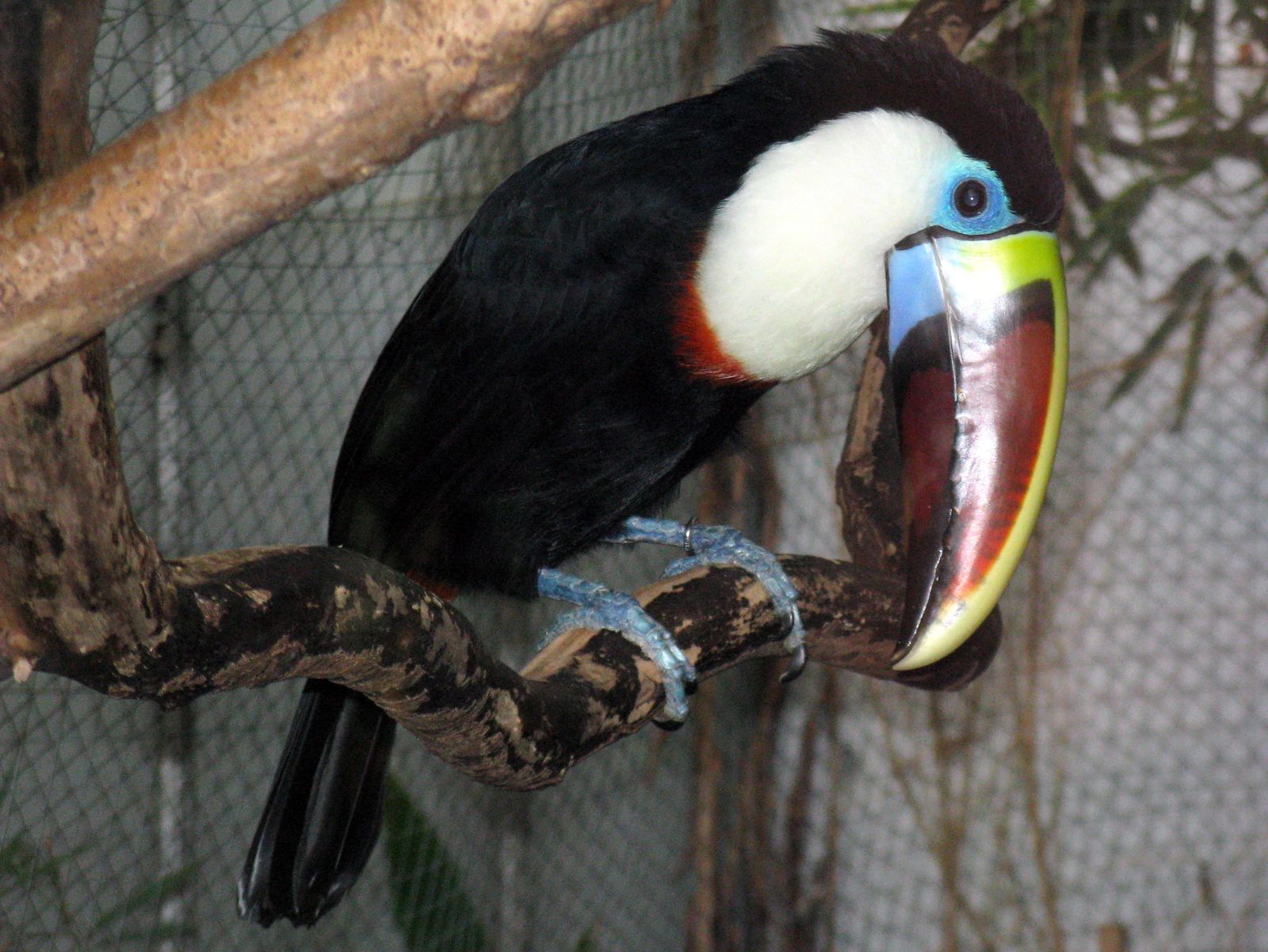
"Toucan" isn't one bird, it's a family, Ramphastidae, with around 40 species spread from southern Mexico down through the Amazon basin to northern Argentina. What they share is the bill: enormous, brightly colored, and much lighter than it looks, built from a keratin shell over a honeycomb of bone struts, not solid material. Researchers who study heat regulation in birds have found that toucans use that huge surface area to dump body heat, flushing blood into the bill to cool down and restricting flow to warm up, essentially running it as a built-in radiator. The size probably also matters for reaching fruit at the end of thin branches too weak to hold the bird's weight, and for signaling to other toucans, since bill color and pattern vary sharply between species and even between individuals.
The species you're most likely to see depends on where you are. In Costa Rica and much of Central America, the keel-billed toucan is the one on the postcards, green-black body, a rainbow bill in green, orange, red and blue. The chestnut-mandibled toucan (sometimes now called black-mandibled toucan after a taxonomic split) is larger and duller-billed but just as common in the same lowland and mid-elevation forests. Head into South America and the toco toucan takes over as the iconic species, the one with the enormous solid-orange bill, more associated with Brazil's Pantanal and forest edges than deep rainforest, since it actually prefers more open country than its Central American cousins. The Amazon basin itself holds a scatter of smaller, quieter aracaris and toucanets, prettier in some ways but far less conspicuous.
Toucans are fruit specialists first, opportunists second. They'll take eggs and nestlings from other birds' nests when they find them, which is one reason smaller birds mob toucans on sight, but the bulk of the diet is figs and other rainforest fruit, tracked from tree to tree as different species come into season. That's the key to finding them: toucans go where the fruit is, and a fruiting fig tree in the early morning is one of the more reliable stakeouts in any tropical forest. Costa Rica's Caribbean lowlands around Boca Tapada and Sarapiquí, the Osa Peninsula around Corcovado National Park, and Panama's Canal Zone forests are all places where seeing multiple toucan species in a single morning is a realistic goal, not a stretch.
Macaws and the clay licks of the Amazon
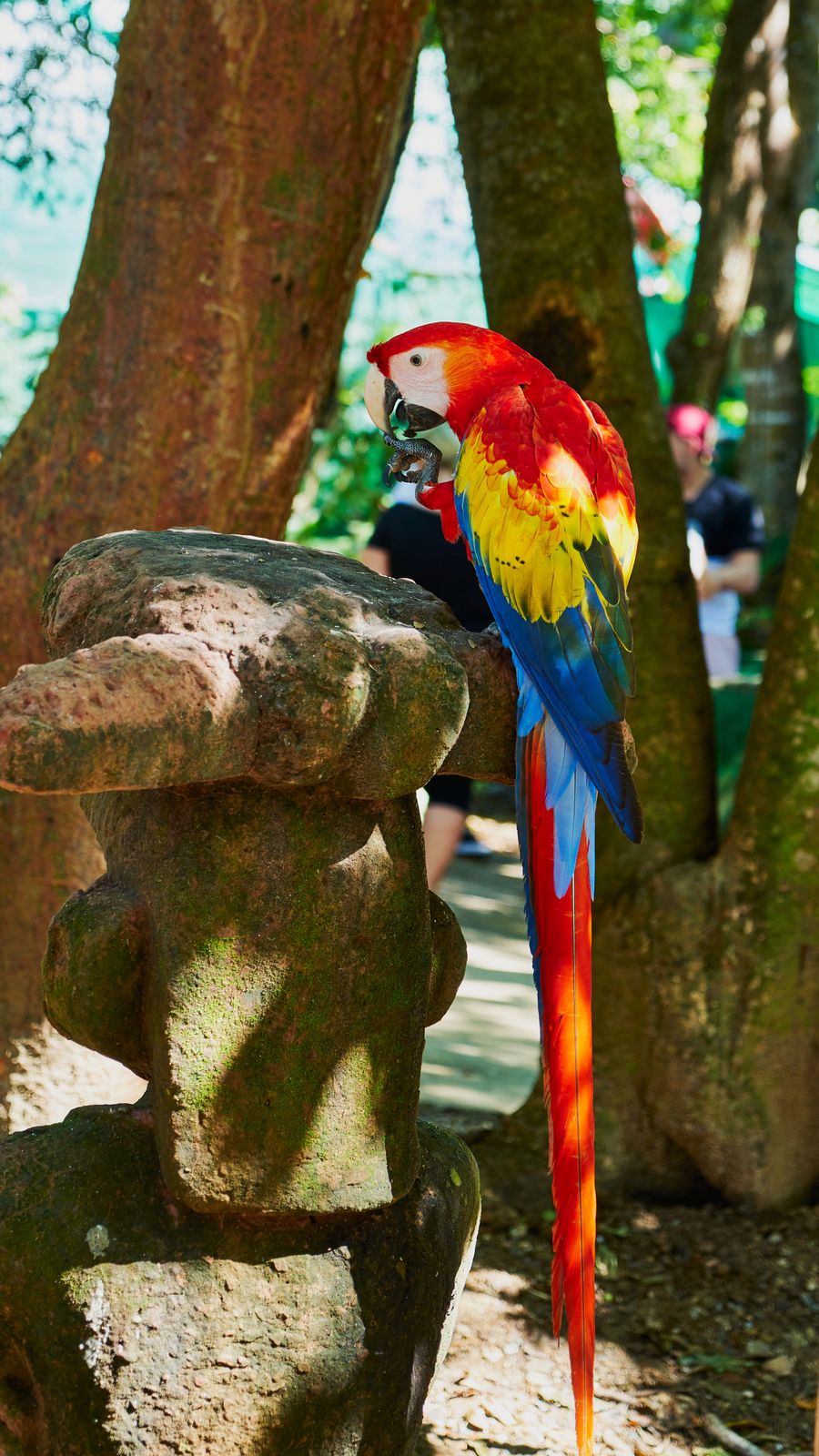
Macaws are the largest parrots in the world, and unlike toucans they're genuinely hard to miss, if they're anywhere near you at all: the scarlet macaw's call carries for a long way, and a pair flying overhead in that unmistakable red-yellow-blue is one of the more startling sights in any jungle, city park included, since scarlet macaws have been reintroduced into parts of their former range near towns in Costa Rica. Macaws mate for life and tend to travel in pairs or small family groups, which is part of why conservationists treat macaw poaching and habitat loss so seriously: losing one bird can functionally remove a breeding pair from a population for good.
The single best macaw spectacle on the continent happens at clay licks, riverbank cliffs of exposed clay along tributaries of the Amazon where hundreds of parrots and macaws gather each morning to eat the soil. The leading explanation is that the clay binds toxic compounds in the unripe seeds and fruit that make up much of the birds' diet, letting them eat things that would otherwise poison them, though sodium supplementation may also play a role. Peru's Tambopata region, reached from Puerto Maldonado, and the more remote Manu National Park are the two places this is most reliably viewable, with licks that can pull in red-and-green, blue-and-yellow and scarlet macaws alongside several parrot and parakeet species at once. Dry season, roughly May through October, gives the clearest access and the most predictable activity, with peak macaw numbers generally reported from August through the start of the wet season around November.
Central America has its own macaw story, and it's a more fragile one. The great green macaw, the second-largest macaw in the world, has lost most of its range to logging and depends heavily on the almendro tree for both food and nest cavities. Costa Rica's northern lowlands around Boca Tapada and the border forests near Nicaragua hold one of the last strongholds of the species, and conservation programs there have worked for years on protecting almendro trees on private land specifically to keep the population viable. Seeing a great green macaw is a genuinely different experience from seeing a scarlet macaw in Tambopata: rarer, quieter, and a reminder that not every big colorful bird in this guide is doing fine.
A fig tree dropping ripe fruit at dawn will do more for your bird list in one morning than three days of walking trails.
The resplendent quetzal: the cloud forest specialist
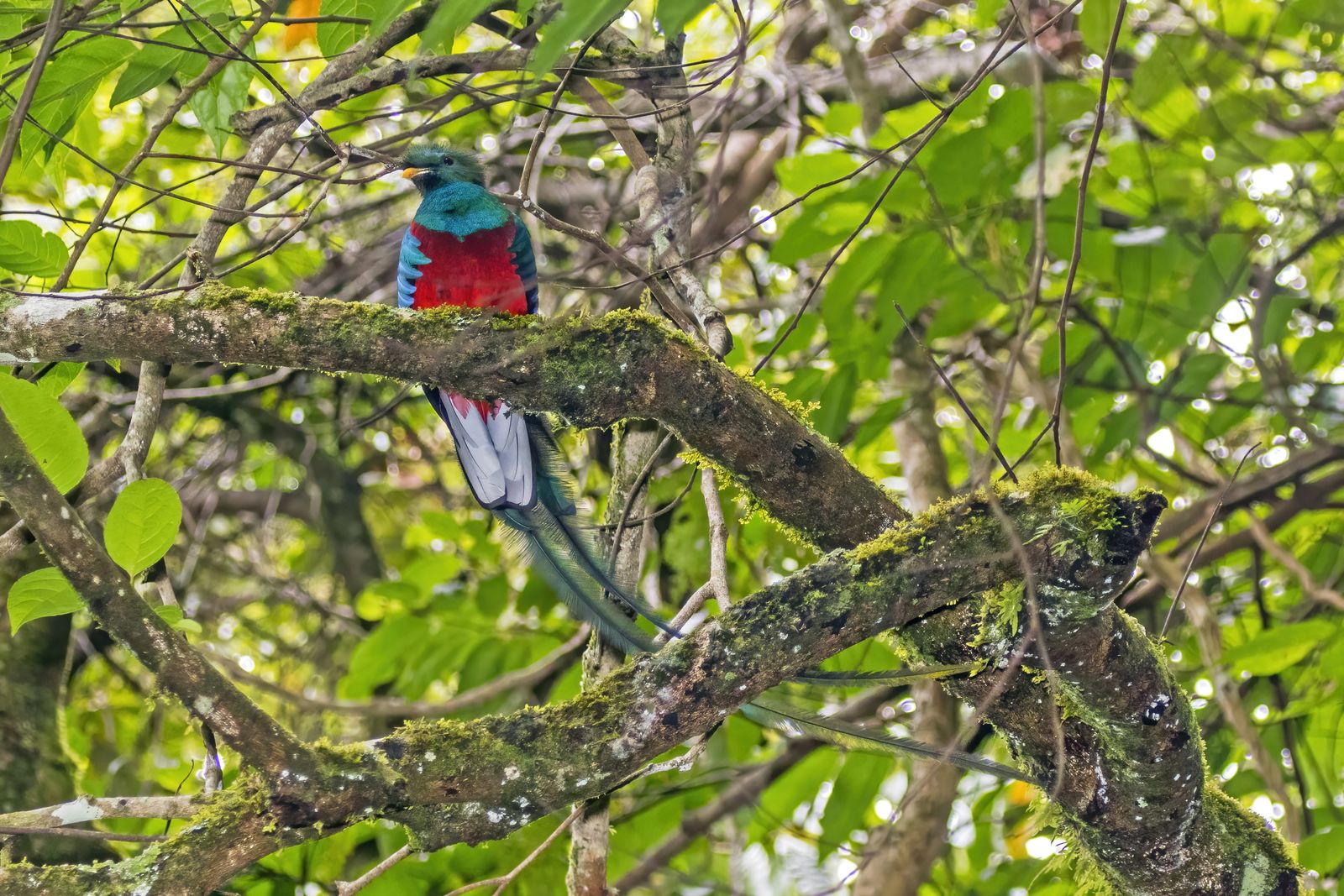
The quetzal belongs to a different world than the toucans and macaws in this guide. It's a trogon, not a parrot relative, and it doesn't live in lowland rainforest at all, it needs cloud forest, the cool, wet, moss-draped habitat that forms at elevation where clouds sit against mountain slopes for much of the day. In Central America that means roughly 1,500 to 3,000 meters up, which is exactly why the resplendent quetzal was sacred to the Maya and Aztec long before anyone wrote a birding guide: it's a bird you have to climb into the mountains to find, spectacularly colored, and for centuries it was believed the bird would die in captivity rather than lose its freedom.
The male is the one everyone comes for: an iridescent green head, back and chest that shifts to blue or gold depending on the light, a red belly, and during breeding season a pair of tail streamers that can trail well beyond the body length of the bird itself. Females are green-bodied and red-bellied too but lack the head crest and the long tail, and are frankly much easier to overlook. Quetzals feed heavily on wild avocados and other fruit in the laurel family, swallowing them whole and regurgitating the pit, which makes them, like toucans, birds you find by finding fruiting trees rather than by wandering trails hoping for luck.
Cloud forest habitat is naturally patchy, restricted to specific elevation bands on specific mountains, so quetzal range is patchy too. Costa Rica's San Gerardo de Dota, a valley in the Talamanca mountains south of San José, has built its whole identity around being the most reliable place in the country to see one, thanks to a dense population of wild avocado trees that keeps quetzals from needing to move far even outside breeding season. Monteverde, Costa Rica's original cloud forest reserve, is the other classic option and considerably more visited. Guatemala's Sierra de las Minas and parts of the Guatemalan highlands, along with cloud forest in southern Mexico, hold populations too, though with less established tourism infrastructure around them. Breeding season, roughly February through June, is when males grow their full tail streamers and activity peaks, with many local guides pointing to March through May as the strongest window for good looks at a fully plumed male.
Good to know
Quetzals are most active in the first two hours after sunrise, often sitting in the open on a bare branch to digest fruit before the day heats up. That stillness is exactly why a good local guide matters here more than almost anywhere else in this guide: they know which avocado trees are fruiting that week, and a fruiting tree can turn a four-hour search into a five-minute sighting.
Hummingbirds: the constant motion
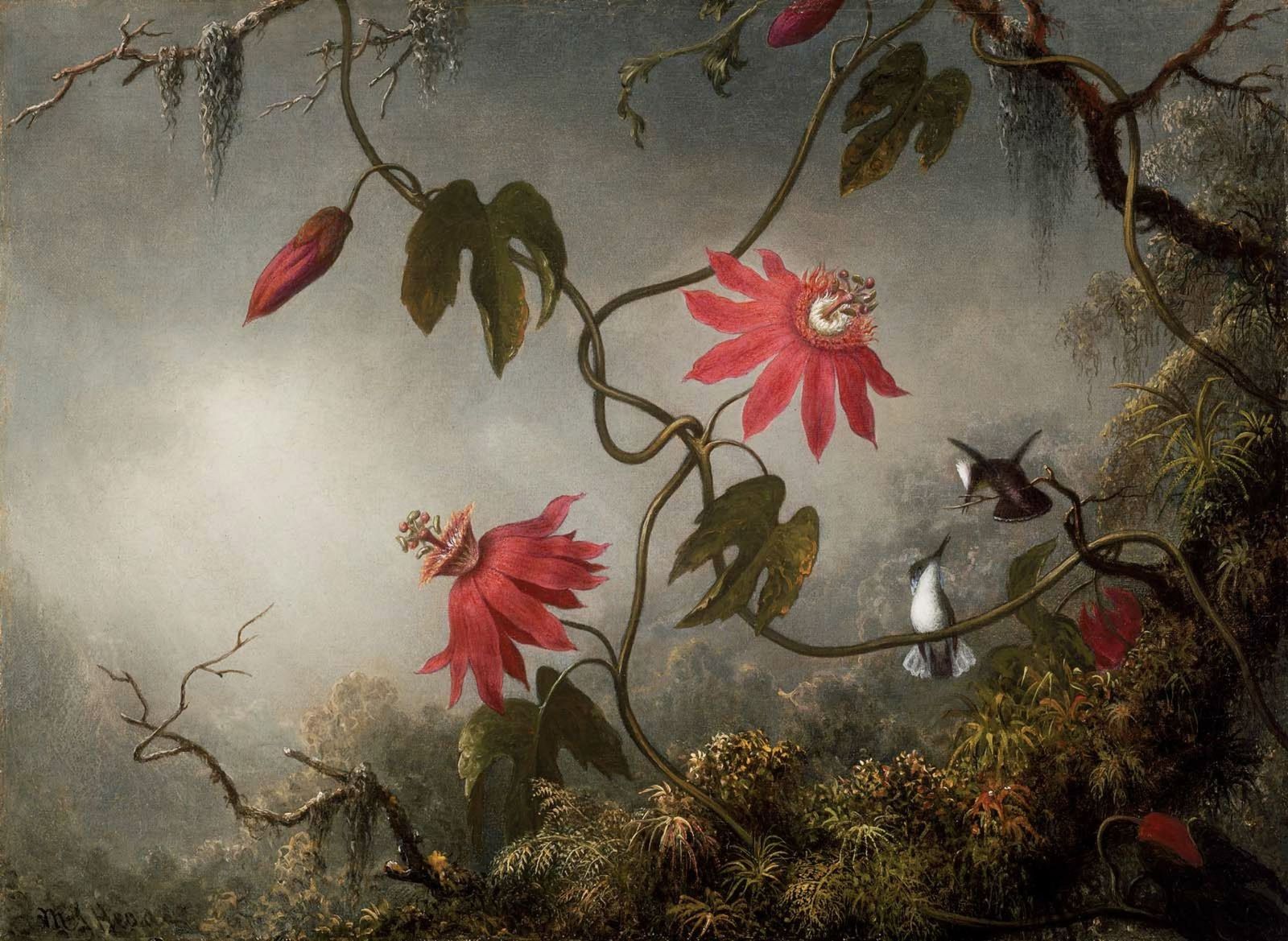
Hummingbirds are a New World story from start to finish. There are more than 300 species and every single one is native to the Americas, from Alaska down to Tierra del Fuego, with the overwhelming majority concentrated in the tropics, especially the cloud forests and lower mountain slopes of Central and South America where flower diversity is highest. Ecuador and Colombia between them account for a huge share of the world's total, but Costa Rica alone has more than 50 species packed into a small country, which is part of why hummingbird feeders at jungle lodges tend to turn into an unplanned hour of standing still with a camera.
The biology is almost cartoonish. Wingbeats run from around 12 per second in the largest species up past 80 per second in the smallest, fast enough that the wing motion reads as a blur rather than a flap, and it's what lets hummingbirds hover in place and even fly backward, something almost no other bird can do. That kind of muscle output needs fuel, so hummingbirds burn through energy reserves fast enough that many species drop into torpor overnight, slowing their heart rate and body temperature dramatically to avoid starving before dawn. During the day a hummingbird can visit over a thousand flowers, and in doing so it does real ecological work: a huge number of tropical plant species, especially ones with long tubular red or orange flowers, are pollinated primarily or entirely by hummingbirds rather than insects.
Unlike toucans, macaws and quetzals, hummingbirds don't require a special trip. They're a background presence at almost any jungle lodge with flowering plants or feeders, from the Costa Rican highlands to the Peruvian Amazon to Colombia's cloud forests, which makes them the one bird in this guide you're nearly guaranteed to see well, often at close range, without doing anything at all.
When to go, season by season
There's no single answer here because the birds in this guide live under different climate systems. In Central America, the dry season, roughly December through April, is generally the easier window for birding overall: trails are passable, fruiting and flowering are still active, and many resident species are gearing up for breeding, which means more calling and more display behavior. Quetzals specifically peak toward the tail end of that window, February through May, when breeding activity is at its height in the Talamanca and Monteverde cloud forests.
The Peruvian Amazon runs on the opposite logic in one specific way: the macaw clay licks are at their best in the dry season, roughly May through October, when lower water levels and drier weather keep the clay exposed and stable and the birds visiting predictably, with numbers often reported as strongest from August into the following months. Visit during the height of the wet season, December through March, and the licks can be less active or partly submerged, even though the rest of the rainforest is still very much alive and green.
Toucans and macaws outside the clay lick context are largely visible year-round across their range, since they're following fruit crops rather than a single migratory or breeding calendar, but early morning is non-negotiable for all of them. Nearly every guide interviewed for pieces on toucan spotting in Costa Rica converges on the same window, roughly 5:30 to 8:00am, when birds are most actively feeding and moving before the heat of the day settles in and activity drops. If you have to pick one habit to adopt for this whole trip, it's setting an alarm.
Birding responsibly
The clay licks, fruiting fig trees and known quetzal territories that make this kind of birding possible are also fragile in ways that are easy to damage without meaning to. A few habits matter more than any gear list.
- Keep your distance and let the guide set it. A local guide at a clay lick or a quetzal nest tree knows the flush distance, the point at which birds get spooked and abandon a feeding or nesting site, and it's usually further back than instinct suggests. Following their lead rather than pushing closer for a photo is the single biggest thing a visitor controls.
- Be skeptical of baiting. Some operators use food to draw birds in close for guaranteed photos. It's a genuinely debated practice among birders and conservationists, since it can alter feeding behavior and, for species like owls, has been linked to birds associating humans with food in ways that put them at risk. If a tour's whole pitch is a guaranteed photo of a wild animal at point-blank range, ask how they get it.
- Support reserves and community-run land, not just parks. A large share of the best birding land in Central and South America, including several of the private reserves protecting almendro trees for the great green macaw, sits outside official national park boundaries on private or community-owned land. Paying for guiding, lodging and park fees in these areas is what keeps that land as forest rather than cattle pasture or farmland.
- Skip the wildlife trade entirely. Parrots and macaws are among the most heavily trafficked bird groups in the world for the pet trade. Never buy a bird, a feather, or anything made from one, no matter how it's marketed at a roadside stand or market.
None of this should make the trip feel like a minefield. Responsible birding in the tropics mostly comes down to going with people who know the land, staying at places that have a real stake in keeping the forest intact, and being patient rather than pushy. That's also, not coincidentally, how you see more birds.
Field tips for actually spotting birds
Big colorful birds still hide well in a forest this dense, and a few habits make a real difference for a first-timer.
Go slow and stop often
The instinct on a jungle trail is to keep walking, but most birds are found by someone standing still long enough for movement or sound to give the bird away, not by covering ground. Walk a stretch, then stop for several minutes and just look and listen before moving on.
Learn a handful of calls before you go
You will hear far more birds than you see in rainforest, full stop. Knowing the croaking rattle of a toucan or the loud, raspy squawk of a macaw pair overhead means you can identify a bird by ear and decide whether it's worth the effort of tracking down, rather than assuming every unseen sound is something too small or too far to bother with.
Watch fruiting and flowering trees, not just trails
As covered above, toucans and quetzals in particular are drawn to specific food trees rather than patrolling territory evenly. A local guide who knows which fig or avocado tree is fruiting that week is worth more than any amount of trail-walking.
Bring binoculars that actually work in low light
Rainforest canopy blocks a lot of light even at midday. A mid-range pair with a wider objective lens, 8x42 is the standard recommendation among tropical birding guides, will show you far more than a compact travel pair, especially in the dim understory or during the low-light hour right after sunrise when the best activity happens.
Dress for stillness, not just hiking
Muted colors, long sleeves against both sun and insects, and comfortable footwear you can stand still in for twenty minutes at a time matter more here than technical hiking gear. Rain is a constant possibility in most of these habitats regardless of season, so a light rain layer belongs in the bag even on a clear morning.
Where to stay for the best birding
Proximity matters more for birding than for almost any other kind of jungle trip, since the best activity happens in the first two hours after sunrise, before most day-trippers have even left a town or city base. Staying inside or right at the edge of the habitat you're after means you can be on a trail or a porch with coffee at first light instead of stuck in a van.
Costa Rica covers the widest range of this guide in the smallest area: lowland rainforest around Boca Tapada, Sarapiquí and the Osa Peninsula for toucans, macaws and a long list of other species, and cloud forest around San Gerardo de Dota and Monteverde for quetzals, often within a few hours' drive of each other. It's the easiest country in this guide for a first tropical birding trip for exactly that reason.
Peru is the pick if the clay lick spectacle is the priority. Lodges around Tambopata and the more remote Manu National Park put you within a short boat ride of licks that can draw in several macaw and parrot species at once, alongside genuinely vast Amazon biodiversity beyond just birds.
Brazil and Colombia, the two most bird-rich countries on the planet, both reward a longer or more specialized trip, whether that's the Pantanal for toco toucans and open-country species or Colombia's cloud forests for hummingbird diversity that rivals anywhere on earth. Neither is a bad first trip, but both are countries a birder tends to return to rather than tick off once.
Whichever region you choose, look for stays that back directly onto forest or reserve land rather than sitting in a town center, and ask, before booking, whether the property or a partner offers an early-morning guided walk. That single detail tends to separate a good birding stay from a great one. Browse the full list of jungle stays across all destinations to compare options by region.
Common questions
What's the difference between a toucan and a hornbill?
They look similar and fill a similar ecological role, big-billed fruit-eaters in the forest canopy, but they're not related and don't share a continent. Toucans are strictly a New World family found from Mexico to Argentina. Hornbills are an entirely separate family native to Africa and Asia. The resemblance is a case of convergent evolution, two unrelated groups landing on a similar body plan to solve a similar problem.
Are scarlet macaws endangered?
Scarlet macaws are not currently classified as globally threatened, but populations have been lost across large parts of their historic range, including much of Central America, due to habitat loss and the pet trade, and some regional and subspecies populations are considered vulnerable. Costa Rica has run active reintroduction programs specifically because the bird had disappeared from areas it once occupied. The great green macaw, mentioned above, is in far more serious trouble and is classified as endangered.
Can quetzals survive in captivity?
Quetzals are notoriously difficult to keep in captivity and there is a long-standing belief, especially in Maya and Aztec tradition, that the bird would rather die than live caged. Whatever the historical truth of that idea, the practical reality is the same: quetzals are essentially never found in zoos or aviaries, because they don't adapt to captivity, which is one more reason seeing one requires an actual trip into cloud forest habitat rather than a substitute closer to home.
Do I need a guide to see these birds, or can I find them on my own?
You can absolutely see toucans, macaws and hummingbirds without a guide, especially around a lodge with feeders or fruiting trees nearby. Quetzals and clay lick macaws are a different story: both depend on knowing a specific, current location, which fruit tree is active this week, which lick is drawing birds this month, and that knowledge lives with local guides, not guidebooks. For those two in particular, a guide isn't a luxury, it's close to a requirement for a good outcome.
What should I bring on a birding-focused jungle trip?
Binoculars are the one non-negotiable item, ideally 8x42 for a balance of brightness and portability. Beyond that: muted clothing, a light rain layer regardless of forecast, insect protection, and a printed or downloaded field guide or app for the region, since phone signal is often nonexistent at the lodges and reserves where the best birding happens.
Is dawn really that much better than the rest of the day?
Yes, consistently, across every species in this guide. Feeding activity, calling and display behavior all peak in the first two to three hours after sunrise, before heat sets in and many birds go quiet and still for the middle of the day. A 5:30am alarm is the most effective single tool available to a visiting birder, more effective than any piece of gear.
Toucans, macaws, quetzals and hummingbirds are four very different birds with four different sets of rules for finding them, but they share one thing: none of them ask much of a visitor beyond patience, an early alarm, and a guide who knows the forest better than you do. Pair this trip with a closer look at where to see sloths in the wild or the monkeys of the rainforest for the rest of the canopy's cast, or read up on what makes a cloud forest different from lowland rainforest before you decide which elevation to chase. Either way, get out before the sun's fully up.
- My Tan Feet — Where to See Toucans in Costa Rica — best regions and viewing hours for toucans in Costa Rica.
- Costa Rica Birding & Wildlife — Best places to see toucans — corroborating detail on Boca Tapada, Sarapiquí and Osa Peninsula toucan habitat.
- Costa Rica Focus — Discovering the Resplendent Quetzal — quetzal breeding season, viewing locations and behavior.
- Mistico Park — Where and When to Watch Quetzals in Costa Rica — San Gerardo de Dota's year-round reliability for quetzal sightings.
- Tour the Tropics — The Best Macaw Clay Licks in Peru — Tambopata and Manu clay lick locations and macaw species present.
- Adventure Life — World's Largest Macaw Clay Lick Near Tambopata Research Center — clay lick ecology and seasonal timing.
- Local Trekkers Peru — Macaw Clay Lick Tambopata Guide — dry-season and breeding-season timing for macaw activity at clay licks.
- Peru Jungle Trips — Macaw Clay Lick in the Tambopata National Reserve — the toxin-binding and sodium-supplementation explanations for clay lick behavior.
More from the Journal.
 Photo: shankar s. from Dubai, united arab emirates, CC BY 2.0
Where to See Sloths in the Wild
The internet's favourite animal is real, wild and findable — where to reliably see sloths, how to spot them, and the stays that put you closest.
 Photo: Michael Barera, CC BY-SA 4.0
The Monkeys of the Rainforest
Howlers waking you at dawn, capuchins raiding the deck — a field guide to the primates you will meet on a jungle stay, and where to meet which.
 Photo: Titlutin, CC BY-SA 4.0
Pink River Dolphins of the Amazon
One of the strangest animals in the rainforest — the pink dolphin of the Amazon. Where to see them, the folklore around them, and how to do it ethically.
 Photo: Derek Ramsey (Ram-Man), CC BY-SA 4.0
Find your own piece of the canopy.
Treehouses, bamboo houses and rainforest villas across 17 destinations — found, vetted and written up honestly.
Browse all destinations